










DISCLOSURE: This is an opinion article. Please note that unsigned editorials represent the collective opinion of The Wingspan student news staff and do not necessarily represent the opinion of the adviser or Gretna East High School. Columns represent the opinion of the author alone and do not necessarily represent the opinions of the adviser, the Wingspan staff or Gretna East High School.
Two months ago, The Wingspan was censored. The issue still isn’t resolved, and, as it turns out, we as a student news staff, are not alone. Several other high schools in Nebraska have faced the same fate to various degrees.
In the past 17 years alone, Westside was censored for reporting on censorship itself, Bellevue East for covering salary negotiations, North Platte for addressing racism and Grand Island Northwest’s Viking Saga was completely shut down for an issue that highlighted LGBTQ issues. And these are only some of the publicized instances, not the ones that students haven’t spoken up about.
These cases aren’t coincidences. They keep happening because there are too few legal protections for student journalists and their advisers, and the few they do have are often misconstrued.
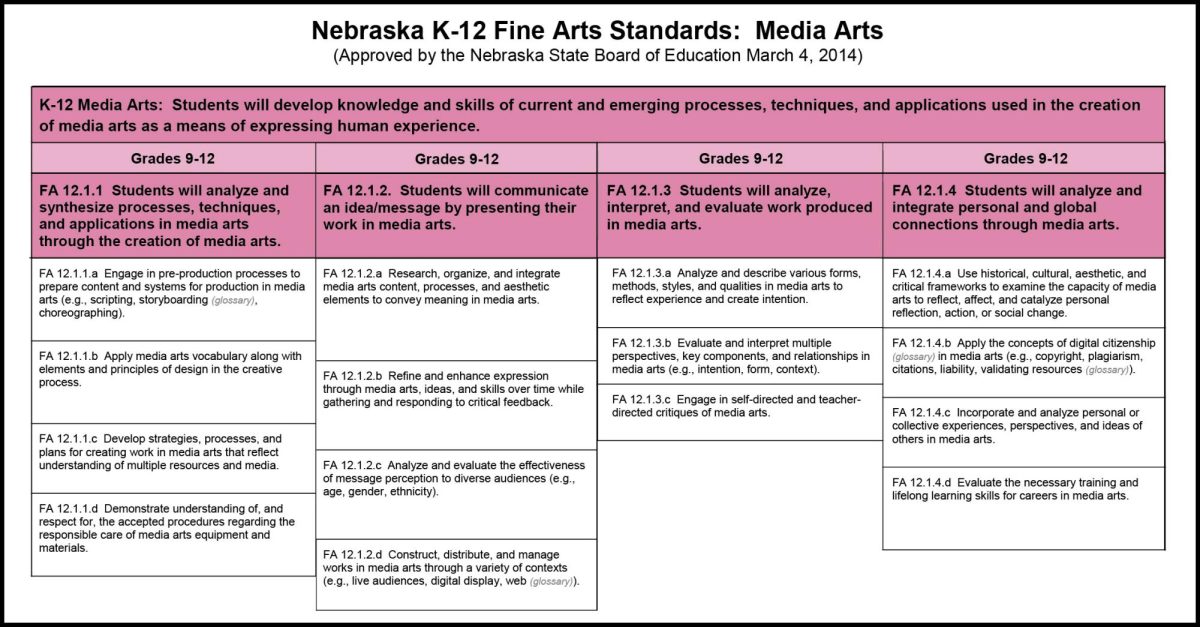
These examples of censorship not only highlight the need for more protections, but also Nebraska’s failure to uphold their own State Board of Education K-12 Fine Arts Standards. The primary objective for the Media Arts section is: “students will develop knowledge and skills of current and emerging processes, techniques, and applications used in the creation of media arts as a means of expressing human experience.”
The legal framework that permits student censorship comes from the precedents of two Supreme Court cases: Tinker v. Des Moines (1969) and Hazelwood v. Kuhlmeier (1988).
In the Tinker case, the Supreme Court ruled 7-2 that neither students nor teachers “shed their constitutional rights to freedom of speech or expression at the schoolhouse gate,” and that schools could only restrict speech that causes “material and substantial disruption.” However, in 1988, the Supreme Court limited the Tinker standard in Hazelwood v. Kuhlmeier. The Court ruled that schools may censor student newspapers for reasons “reasonably related to legitimate pedagogical concerns.”
Because “legitimate pedagogical concerns” is not clearly defined, Hazelwood gives school administrators significant discretion to censor student publications. And while the phrase sounds neutral, it can be used to mask disagreement with a message. For example, an administrator could claim an article is “inappropriate” or “not aligned with educational goals” when the real issue is that it’s critical or controversial.
“People want to protect others from harm, but not all harmful ideas warrant censorship,” Emily Kubin, a post-doctoral research fellow in the Department of Experimental Psychology at the University of Oxford, said. “Telling children about death can cause them distress, but we still often do it because the existence of death is true, and children need to learn to cope with that reality.”
When administrators have broad control over student publications, student journalism stops being journalism and starts becoming public relations. Students become less willing to tackle difficult issues, schools can avoid criticism, and young reporters lose the chance to practice real-world journalism built on inquiry, truth and accountability. Instead of preparing students for the realities of a free press, censorship teaches them to stay quiet and avoid uncomfortable truths.
Journalism exists to inform the public, expose corruption, hold the powerful accountable and protect people from misinformation. Student journalism should serve that same purpose. Yet when schools decide what students can and cannot report, journalism becomes inconsistent and dependent on individual administrators rather than a shared standard of truth and transparency.
This issue reaches far beyond the school newspaper. High school is where students learn to think independently, question authority and develop their own voices. Restricting student expression sends the message that their perspectives do not matter. A healthy democracy depends on citizens who know how to ask hard questions, and student journalism is one of the first places young people learn how to do that.
Furthermore, fear of administrative censorship often leads student journalists to self-censor. In a survey of 531 students and 69 advisers conducted at the 2013 National High School Journalism Convention in Boston, Mass., 32% of students and 28% of advisers admitted they had decided not to publish something because they believed that their school officials would censor them.
Ava Kate White, a senior at Little Rock High School who started the New Voices Arkansas Coalition in 2025, experienced these consequences firsthand.
“Self-censorship is just as bad as regular censorship from the administration,” White said. “We’re students, we’re at a very fundamental time in our learning. If we’re watching our advisers, the people that we see as mentors, facing retaliation for our work, because we’re simply holding people accountable, that just messes up the entire standard of journalism.”
White’s comments highlight a larger problem: when censorship becomes expected, students begin silencing themselves before administrators ever have to intervene, something the Journalism Education Association (JEA) Nebraska State Director, Erica Brockmoller, says is an issue in the state. The award-winning journalism adviser from Lexington High School believes that legislation would help by eliminating uneven standards that currently determine how frequently students self-censor.
“It is all dependent on where you go to school– if you can speak freely and research and provide sound journalism to the rest of your student body,” Brockmoller said. “I think it’s really important that we try to get a bill passed [to protect student journalists and their advisers].”
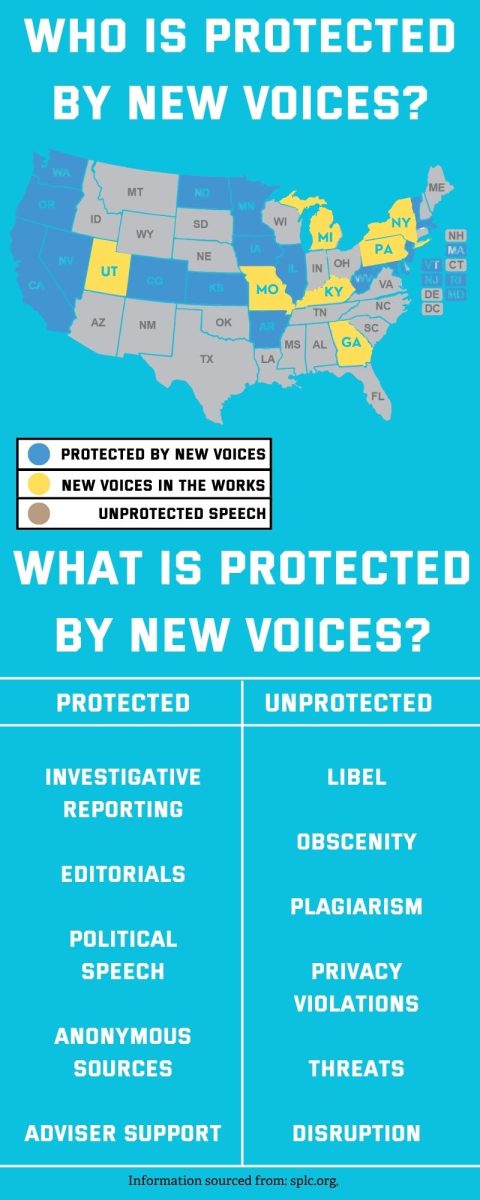
That’s exactly why 18 states have passed “New Voices” laws that reverse the Hazelwood standard and restore the Tinker ruling. These laws protect student journalists from administrative censorship and protect advisers from retaliation for supporting student press freedom.
New Voices laws establish consistent legal standards that protect responsible student journalism while still holding students accountable to ethical and legal standards. They do not shield libel, privacy violations, factual inaccuracies or vulgar content; rather, they ensure students can responsibly report on issues that matter and develop into informed, engaged citizens. Without New Voices legislation, those opportunities are at risk.
“One of the benefits of passing New Voices is that you would get an authentic view of what’s happening at the local level, for many students and their publications,” Brockmoller said.
There have already been three attempts to pass New Voices legislation in the state, but none of them were successful. LB206 was postponed in 2019 due to historic flooding in the state, and then again in 2020 due to the COVID-19 pandemic. Then, in 2021, LB88 ended in cloture with a vote of 30-17-2 (Yay, Nay, Present, not voting).
Unfortunately, it took us personally getting censored to realize that we needed to do something. However, now that we have, a spark has been lit; our fight has begun. Nebraska needs New Voices legislation: for all of the publications silenced before ours, for ours right now and for all that will follow if nothing changes.
Five years after Nebraska’s last New Voices bill was defeated, students are still waiting for protections that many other states already recognize as essential. If Nebraska truly values civic engagement, transparency and education, then lawmakers and communities alike must support a new New Voices bill and protect the rights of student journalists to report freely and responsibly.
Rise Mitchell • May 16, 2026 at 3:45 pm
As a student journalist in the Sidney Nebraska high school for the years of 1970 and 1971, I feel I have a valid perspective. If you recall, these were very tumultuous years in the United States. The dragging on and on Vietnam war, Kent State, and daily protests sparked many personal opinions about the current state of thought in America. We were never censored for what we wrote. In fact, it never occurred to me that we would be censored.
I can’t help but believe that part of the censorship climate in the United States has a direct link to the way our national government conducts itself. Many things we know to be true, are not acknowledged consistently by our national political leaders. It’s not hard to connect the dots.